For everyone in modern-day tech companies, the role of Product Manager (PM moving forward) is highly visible. But it wasn’t long ago that PM was widely unknown, thought unnecessary, or even undesired by most teams or companies. So what changed?
*Quick note: This is a very high-level intro that takes liberties with some generalizations and takes a reductive approach to a complex position. Otherwise, this would be a novel, so I have distilled this down into something as helpful as possible for your attention span :)
Know your history…
or you will be doomed to repeat it (Steve “The First PM” Jobs)
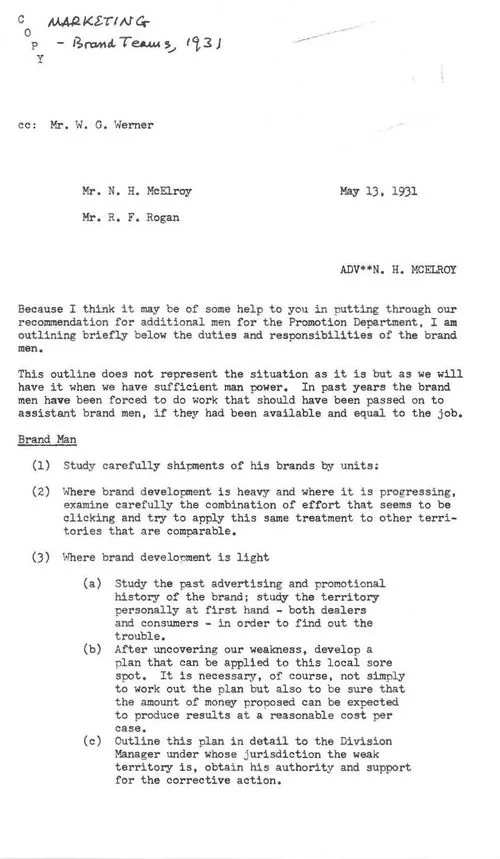
First, it only takes a quick Google to notice that the title brings a ton of conflation. Search for “History of Product Management,” and you’re pointed to a 1930s memo. McElroy wrote it for Procter & Gamble, and that memo gets credited with creating the first PM role. Maybe a little revisionist history, especially when the memo called for a role dubbed “Brand Men” heavily based on applying the scientific method to brand advertising.
With the wide variation of PM roles and responsibilities, it’s understandable to tie grandiose narratives to the discipline. A much more common one being Silicon Valley CEOs were the first PMs. This alone has caused many conflicts with teams and organizations hiring PMs. It’s hard not to cause friction when a PM is called “mini-CEO.” In the end, it’s a position like any other… Ok, slightly different, but we’ll get more into that.
A little background on me: my product career spans a time when PM wasn’t even a widely used position outside the US West coast tech hubs. Fortunately, maybe unfortunately, I’ve had experience being the first PM in a few organizations that saw it as the shiny new tool that will 10x revenue regardless of other factors.
I wish I had the experience or foresight to see the many traps ahead. Each position came with the expectation of teaching the position while figuring it out for myself, so you can imagine learning from my mistakes was a common theme. Along the way, I leaned hard on first principles thinking, using one mistake to spot the tangential problems waiting behind it so I’d stop repeating the same errors.
I aim to shed light on the most fundamental requirements of a solid PM. This also comes with understanding who can/should be a PM: surprise, you need previous experience. As I said, it’s like any other team member, but it also comes with larger accountability and expectations.
What makes a Product Manager?
Regardless of the organization, PMs will tell you they get pulled in all directions, and every day is different. So how do you hire or develop based on a “jack of all trades” job spec, with the expectation of having depth in these categories?

One of the recurring issues is mismatched expectations between the companies, studios, or teams a PM lands in. It’s disappointing to see the lack of definition for the role that 80% of the industry holds but continues to hire based on “This is what [big/successful company] does, so should we!” Then leave their new PM to struggle. But how could they help? They aren’t equipped with the experience of working with the role?!
Let’s start with what doesn’t make a PM. I believe PM is a prestige-type role, not to be confused with a prestigious role! What I mean is you cannot be an effective PM without some type of parallel experience.
This is not a role you can hire out of school. You don’t go to school for product management, come out at 22, and start kicking ass “by the book.” And an MBA certainly does not equal a good PM. There’s too much nuance to learn to be sufficient at the position. And this gets me to what I mean by prestige: you need to have transferable experience. It doesn’t matter where.
Some of the best PMs I’ve worked with came from different disciplines like marketing, recruitment, QA, and the most popular data analytics. The jack of all trades moniker rings true, but depth somewhere is necessary. I’ll give a story from my days at university to explain what kind of depth.
I was just getting into my specialization in finance when rumors spread that a history major from our university got an analyst-type job at a prestigious investment firm in the region. It was unfathomable to think this was possible at the time, “what the hell does a history major know about finance” I remember thinking. But whatever, rumors are rumors, and this couldn’t be true… Until I met this person at a dinner with friends when I had a foot inserted to mouth moment.
It was only after I made a stupid joke about historians being hired at this firm that he spoke up. What he said changed how I view what it means to find the right person for the right job. He basically summed up his hiring experience in a few sentences.
“In finance, you get all these certifications after being hired. So the technical stuff is actually learned on the job. Fundamental skills are useful for anything. I didn’t walk in as a Historian, I was the best researcher they would meet for that position!”
Holy crap, did this guy turn my evaluation framework upside down. It’s something that stuck with me and something I’ve noticed good managers and leaders use when looking for those “right people.”
Obviously, he had several tools beyond being a good researcher: the approach showed thinking outside the box, charisma, problem-solving, and clever marketing. These are things you don’t want to teach and likely won’t, so teach skills, mental models, and frameworks a PM can use and iterate on instead.
Of course, larger orgs like EA or Zynga can take on the additional capacity to grow talent internally. Still, most can’t afford the time, effort, or organizational size needed for the approach. As a result, I’ve seen a lot of excellent talent jump into the role without the necessary understanding or essential tools to perform.

Conclusion
The meat and potatoes
Coming up!
These will come when I have the open time to tackle and are not listed in order
- Core Competencies
- Gaming Lifecycles and their implications
- Compulsion Loops
- Creating your Backlogs
- Roadmapping
- Goals
- Forecasting revenue
- Forecasting feature impacts
- Creating a Vision, Pillars, and Values