The Adoption–Adaptation Gap: What 12,000 Years of Technological Change Tell Us About AI
Two Months
That’s roughly how long it took ChatGPT to reach 100 million users.
The number is imperfect. It measures estimated monthly users, not ownership, daily reliance, or economic impact. But it captures something real: a capability that most people had never touched in November 2022 became part of the global conversation before the season changed.
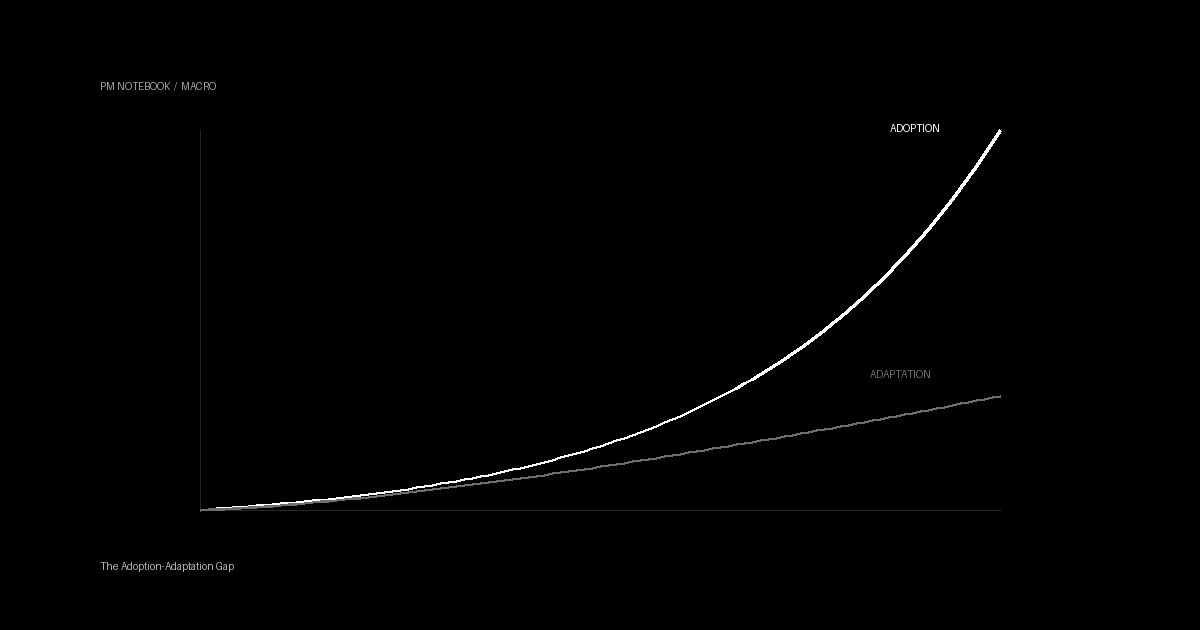
That’s the adoption clock. The second clock gets talked about far less.
Adoption is when people start using a technology. Adaptation begins when institutions, culture, and everyday behavior rebuild around what that technology enables, along with what it destroys.
We adopted smartphones in a few years. We still haven’t fully adapted. Democratic institutions built for print-era information flows now operate inside algorithmically amplified outrage cycles. Schools negotiate with devices designed to interrupt attention. Parents improvise rules for childhoods that no previous generation experienced.
The technology arrived and the governing logic didn’t.
In 2013, I was helping set up Facebook user-acquisition campaigns for mobile games. I opened the targeting controls and started scrolling: interests, relationships, location, behavior, and the rest of whatever someone had handed over to a profile. Every one of them a dial I could turn.
There were no guardrails on any of it.
More than a decade later, we’re still negotiating the consequences of turning human attention into an auction. The platforms changed faster than the society using them.
That interval is what I mean by the adoption–adaptation gap.
The idea has close relatives. William Ogburn called it cultural lag. Stewart Brand described civilization as layers moving at different speeds. David Collingridge identified the control problem: a technology is easiest to govern before its consequences are clear, then hardest to govern once it’s embedded. More recently, The Technology Fallacy distinguished between adoption, organizational adaptation, and institutional assimilation.
What follows traces that lag across twelve thousand years and asks one question: what changes when the adoption clock starts compressing toward zero?
Contents
- Two Months
- Where the Comparison Breaks
- The Two Clocks
- Agriculture, Bronze, and the Axial Turn
- Classical Empires: The Limits of Scale
- The Islamic Knowledge Network
- Print and Gunpowder: Two Monopolies Fall
- Industry and Electricity: Labor Becomes the Gap
- Nuclear Weapons and Mass Media
- The Internet: An Open Loop
- Three Ways Adaptation Fails
- The One That Moved Fast
- The Panic Loop
- What a Modern Meiji Moment Requires
- K=0.73: The Coordination Problem
Where the Comparison Breaks
History should make anyone nervous about calling a technology unprecedented.
People once diagnosed novel-reading as “reading fever.” The railway produced a contested medical category called “railway spine.” Newspapers, telegraphs, telephones, radio, comics, television, and video games all triggered claims that the new medium would damage minds, dissolve families, or make social order impossible.
Some fears were absurd. Others carried a signal but aimed it at the wrong mechanism. The Luddites understood exactly what was happening to their bargaining power, and they only look wrong if you reduce their revolt to a hatred of machines.
AI deserves the same skepticism. A dramatic prediction doesn’t get more accurate because the person delivering it is wearing a lab badge.
But the comparison breaks in two places.
First, most historical panics were claims about behavior: reading makes people hysterical, comics produce delinquency, video games produce violence. The serious AI argument is about agency, about whether humans stay meaningfully involved in the decisions that allocate work, credit, information, weapons, and political attention.
Behavior and agency are different categories of risk, and the old analogies only cover the first one.
Second, AI can participate in the production of AI. Models already help write code, analyze experiments, generate synthetic data, and inspect other models. I’m not claiming this is an autonomous intelligence redesigning itself in a sealed room, because it isn’t. The honest description is a feedback loop: better tools shorten the research that produces the next generation of tools. I build agentic AI systems for a living (Alexandria, Higher Agency), so count me as an interested party watching that loop from the inside.
For the first time, then, the adoption clock may influence its own speed.
That makes the historical record more useful, not less. What happens, repeatedly, when capabilities scale faster than the institutions built to contain them? That’s the question the rest of this essay tries to answer.
The Two Clocks
Every major technological transition runs at least two clocks.
The adoption clock measures the spread of a capability. The adaptation clock measures the response: new laws, organizations, norms, philosophies, and bargains between winners and losers.
The fair objection to this whole essay is that the two clocks can’t be compared with laboratory precision across twelve thousand years, and I’m about to compare them anyway. Agriculture diffusing between regions isn’t the same measurement as a consumer product reaching 100 million accounts. A labor law isn’t the same endpoint as a religious settlement. “Resolved” is the most dangerous word in the exercise; history rarely resolves anything so neatly.
So treat the timelines in this article as historical markers, not a commensurable dataset. The argument is qualitative:
- New capabilities redistribute surplus, information, force, or coordination power.
- Institutions designed for the previous distribution struggle to govern the new one.
- Societies attempt a new settlement through law, organization, culture, or philosophy.
Sometimes the settlement works. Sometimes it lands a generation late, and sometimes it fixes one problem while quietly building the machinery for the next one.
That last case is the one nobody plans for.
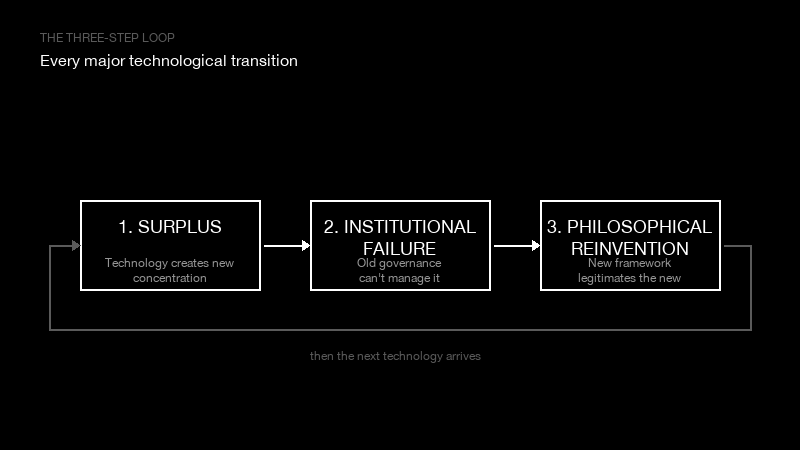
The model is a heuristic, not a law. Technologies can distribute power instead of concentrating it, institutions can learn before they collapse, and philosophy can precede the capability it later helps govern. Multiple causes always operate at once.
What matters is the recurring mismatch: capabilities change quickly; legitimacy, governance, and social bargains change slowly.
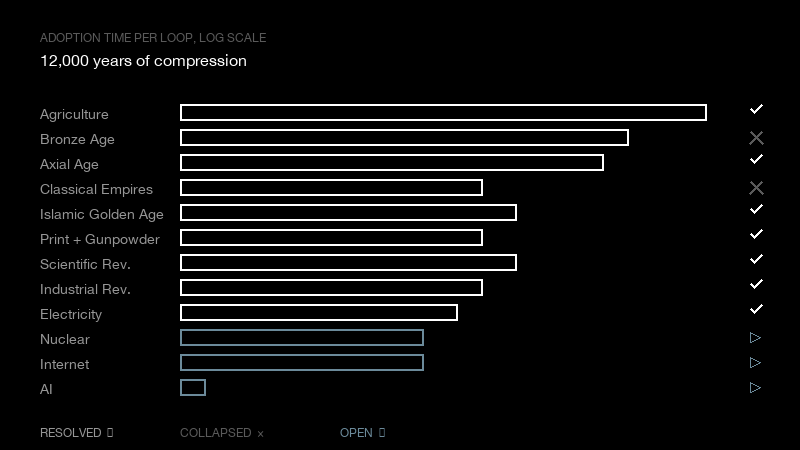
With that caveat filed, the transitions below show the pattern from several different angles.
Agriculture, Bronze, and the Axial Turn
Agricultural transition, beginning roughly 10,000 BCE. Diffusion: millennia. Adaptation: uneven and measured in generations.
Around 3,200 BCE, scribes in Uruk pressed wedge-shaped marks into wet clay. The earliest surviving proto-cuneiform tablets are administrative records of grain, livestock, labor, and rations; civilization learned to write because somebody needed to keep the accounts.
Agriculture had already emerged independently in multiple regions. Farming could support denser populations than foraging, and density enabled specialization, armies, taxation, monumental construction, and people who could spend their days administering everyone else’s grain.
It also carried costs, and they weren’t small. Archaeological evidence from many early farming populations shows narrower diets, more infectious disease, dental decay, and new forms of inequality. The effects varied by region, crop, and population, but the broad trade shows up again and again: farming could increase a group’s productive and military capacity before it improved an individual’s life.
Once grain could be stored, someone had to count it, defend it, allocate it, and explain why that allocation was legitimate. Priests, warriors, administrators, and rulers became durable social roles. Hierarchy predates farming, but storeable surplus made it scalable.
The worldview followed the material system. Divine kingship and cosmic order placed rulers between ordinary people and the natural cycles on which survival depended. Temple and palace institutions did more than seize surplus; they coordinated irrigation, storage, defense, ritual, and relief. The arrangement was productive enough to endure, unequal enough to require justification, and complex enough to generate the first large administrative systems.
That complexity deepened in the Bronze Age. Bronze requires copper and tin, which seldom occur together, so producing it at scale depended on trade routes, specialized labor, secure transport, and political authority. The metal was a material technology held inside a coordination technology.
Across the eastern Mediterranean, palace economies connected farms, workshops, ports, armies, and distant suppliers. The system produced extraordinary wealth and administrative reach, but the same integration that made it powerful also made it vulnerable. Beginning around 1200 BCE, many of those centers fell amid a combination of conflict, migration, drought, internal revolt, trade disruption, and institutional fragility.
Letters from Ugarit describe enemy ships and cities under attack. Soon afterward, the city’s administrative system disappeared. There was no single domino and no universally accepted cause, but the pattern is recognizable: the shock moved through an interdependent network faster than its institutions could respond.
The collapse didn’t simply swap bronze for iron, and ironworking was neither immediate nor universally decentralized. What followed was a long regional reorganization in which smaller polities, new trade patterns, alphabetic writing systems, and more widely available iron tools altered the cost of rebuilding political power. The old palace system never came back in its previous form.
Centuries later, between roughly 800 and 200 BCE, several intellectual traditions made a related turn toward reflective ethics. Karl Jaspers called this the Axial Age. The category is debated, and with reason: the societies weren’t completely disconnected, the timing wasn’t truly simultaneous, and earlier cultures already possessed rich moral traditions. Even with those limits, the comparison remains useful.
Buddhist thought treated suffering as a universal condition instead of a private misfortune. Confucian ren connected humane conduct to legitimate government. Socratic inquiry made the examined life a philosophical obligation. Hebrew prophets placed justice above the correct performance of ritual and made rulers answerable to a moral authority beyond themselves.
These traditions had different doctrines and didn’t arise as a mechanical response to farming or political collapse, yet they shared a bigger moral unit. Each developed ways to judge the person, the ruler, and the social order by standards that could travel beyond a single palace or tribe.
Agricultural civilization had created durable surplus and hierarchy thousands of years earlier. The philosophical turn supplied portable frameworks for criticizing what that hierarchy had become. The lag is too tangled to reduce to one number, but the sequence sets the pattern: material and administrative capability can precede the language a society needs to govern it.
Classical Empires: The Limits of Scale
Classical empires, roughly 500 BCE onward. Administrative capacity expanded quickly; durable political adaptation remained uneven.
The ethical traditions of the Axial period didn’t stay outside power. Rulers borrowed them, codified them, and turned them into statecraft. Confucian learning shaped imperial administration in China, Buddhist institutions traveled with trade and patronage, Greek philosophy entered Roman education, law, and political argument, and Hebrew traditions developed under and against successive empires.
The resulting states solved coordination problems earlier systems couldn’t touch. Roads, coinage, taxation, law, military logistics, and standardized administration connected territories across enormous distances. Scale set a trap, though: every expansion increased the resources an empire could command while also raising the cost of borders, bureaucracy, succession, and coercion.
Rome makes the tension visible. Institutions built for a city-state were modified again and again to govern a Mediterranean empire. Citizenship expanded, provincial administration professionalized, and law became a durable coordination layer. Those were genuine adaptations, and it’s lazy to read them as symptoms of decline.
Even so, the fiscal and political system came under severe pressure in the third century. Roman coinage was repeatedly debased as governments tried to meet military and administrative costs amid civil war, invasion, and disease. Diocletian’s Edict on Maximum Prices in 301 CE attempted to restrain inflation through an empire-wide schedule of prices and wages, but an edict couldn’t repair the production shortages, monetary instability, and enforcement problems beneath it.
What’s the useful analogy here? Not the crude one, where Rome collapsed because it printed money and modern states are replaying 301 CE. The useful version is about reflex: a familiar institutional response (extract more, regulate harder, centralize further) loses effectiveness once the system has outgrown the conditions it was designed for.
Rome’s western political structure fragmented over centuries; there’s no date you can circle. New kingdoms, the eastern empire, the Church, cities, estates, and monasteries inherited different pieces of its administrative and cultural machinery. Augustine wrote The City of God while Roman authority in the West was visibly failing, reframing political collapse inside a religious history that didn’t depend on any earthly empire surviving.
Monasteries later preserved and copied part of the classical archive, but the popular image of monks as solitary hard drives rescuing an otherwise lost civilization doesn’t hold up. Byzantine scholars, Islamic translators, urban schools, private libraries, and many anonymous copyists carried different bodies of knowledge through different routes. Preservation itself was a distributed institutional adaptation.
Sometimes the response to technological and political overextension never becomes a settlement at all. What you get instead is a set of lifeboats, each carrying enough forward for another system to build upon.
The Islamic Knowledge Network
Islamic scholarly expansion, eighth through thirteenth centuries and beyond. A translation and research network connecting several intellectual traditions.
Between the eighth and thirteenth centuries, cities across the Islamic world became the center of an unusually productive knowledge network. Baghdad, Córdoba, Cairo, Damascus, Bukhara, and other centers connected scholars working in Arabic, Persian, Greek, Syriac, Hebrew, and Sanskrit traditions.
Paper helped the network scale. It had originated in China and spread west through Central Asia; by the Abbasid period, paper production and book markets supported a manuscript culture less constrained by the cost of parchment. Knowledge that had required a court or monastery could circulate through libraries, schools, hospitals, observatories, and commercial bookshops.
Translation was only the first layer, and the “scholars kept Greek work warm until Europe was ready to collect it” version of the story undersells everyone involved. Al-Khwarizmi systematized algebra and helped transmit the numeral system developed in India. Ibn Sina’s medical and philosophical works became authorities across several intellectual worlds. Ibn al-Haytham combined mathematical analysis with controlled observation in his study of optics. Astronomers corrected inherited tables, physicians organized clinical knowledge, and philosophers argued over the relationship between reason and revelation.
The network later connected to Latin Europe through several routes, including Sicily, Iberia, trade, and translation centers such as Toledo. Gerard of Cremona and others translated works from Arabic into Latin, including both Greek texts and original scholarship written in Arabic. What Europe called recovery was also transfer, extension, and reinterpretation.
The older version of this story ended too neatly: al-Ghazali attacked philosophy, the Mongols destroyed Baghdad, and scientific inquiry moved to Europe. That sequence turns centuries of political, economic, and intellectual change into a morality play.
Al-Ghazali criticized specific claims made by philosophers while also writing works of logic and theology; later Islamic philosophy and science continued in many regions. The Mongol sack of Baghdad in 1258 was catastrophic, but Baghdad wasn’t the network’s only node, and scholarship didn’t end with the Abbasid caliphate. Patronage shifted, institutions changed, and different fields flourished or contracted at different times.
The stronger lesson is about infrastructure. A civilization advances knowledge when it lowers the cost of recording it, creates institutions that reward translation and criticism, and lets ideas cross political and linguistic borders. It loses momentum when those routes narrow, patronage fragments, or authority makes fewer kinds of inquiry safe.
Knowledge has no permanent home in the society that generated it; it moves toward whichever institutions can carry it.
Print and Gunpowder: Two Monopolies Fall
Print and gunpowder, fifteenth century onward. Adoption: decades in parts of Europe. Political adaptation: centuries and never complete.
In 1492, Abbot Johannes Trithemius wrote In Praise of Scribes, a defense of hand-copying against the printing press. Print, he warned, would democratize error, weaken discipline, and flood culture with low-quality text.
He had the argument printed, which made him early rather than entirely wrong.
Print broke an information bottleneck. Books remained expensive and literacy remained unequal, but reproduction moved from a room of trained copyists toward a repeatable commercial process. Millions of books circulated in Europe within decades of Gutenberg. Luther’s arguments could be copied, translated, sold, and contested at a speed no church council could match.
Commercial incentives mattered as much as doctrine. Printers expanded the market by publishing in vernacular languages, helping to standardize those languages and giving distant readers a shared body of stories, arguments, and news. Benedict Anderson later described nations as “imagined communities”: people who would never meet could nevertheless understand themselves as part of the same public.
Gunpowder broke a different monopoly. A knight represented years of training and concentrated wealth, and firearms lowered the training barrier. Artillery made traditional fortifications more expensive to defend and helped shift military power toward states capable of financing larger armies and cannon.
One technology weakened control over information while the other restructured control over force.
What followed wasn’t a clean march toward modernity: propaganda, censorship, revolt, state-building, religious war, commercial publishing, and new forms of surveillance, all of it running at the same time.
Why so violent? Because the press did more than add information to a stable order: it weakened the institutions that had decided which interpretations were allowed to circulate. The Reformation, peasant revolts, confessional state-building, and the Thirty Years’ War can’t be pinned on print alone, but print changed their speed, reach, and organizational possibilities.
Adoption also varied sharply. Printing in Arabic script developed under different technical, commercial, political, and religious constraints than printing in Latin script. The Ottoman case is often reduced to a blanket ban imposed by rulers frightened of knowledge. In practice, Jewish and Christian communities printed inside the empire earlier, while Ottoman Turkish Muslim printing faced restrictions and resistance before the press of İbrahim Müteferrika opened in 1727. The delay was real, but its causes were institutional, which is a different thing from civilizational incapacity.
The Peace of Westphalia in 1648 is often treated as the moment Europe invented modern sovereignty. That’s too tidy. Its principles had precedents, its reach was limited, and religious conflict didn’t end. But it was part of a political settlement that made coexistence between competing confessional powers more governable than permanent war.
The deeper adaptation was epistemic, because print made knowledge cumulative. A claim could be published, criticized, corrected, and reproduced across borders. Bacon, Descartes, Newton, Locke, Hume, Smith, and the rest didn’t emerge because one machine mechanically produced an Enlightenment; print helped build the infrastructure through which their arguments could accumulate and travel.
Scientific societies, journals, correspondence networks, and standardized diagrams turned private observations into claims that others could inspect. Philosophy and engineering increasingly occupied the same conversation. In eighteenth-century Scotland, Hume and Smith wrote inside an intellectual environment connected to instrument makers, physicians, merchants, and engineers such as James Watt. That’s a long way from simple causation, but it shows how a communication infrastructure can make ideas and machines feed each other.
The political products were equally consequential. Individual rights, consent of the governed, religious toleration, and constitutional limits existed as arguments before they became institutions. Printed controversy let those arguments acquire constituencies, cross borders, and survive their authors. Declarations and constitutions later condensed generations of conflict into governing documents, even when their promises were applied selectively or hypocritically.
Truth became more reproducible. Political legitimacy became more debatable. Nations became imaginable at larger scale through shared vernacular texts.
The capability moved in decades, while the political and philosophical settlement took generations and remained partial.
Decades against generations. Remember that ratio, because it’s about to get worse.
Industry and Electricity: Labor Becomes the Gap
Industrialization, eighteenth through twentieth centuries. Adoption: uneven across countries and industries. Adaptation: a sequence of contested labor settlements.
In 1842, twenty-two-year-old Friedrich Engels arrived in Manchester to learn the family cotton business. Instead, he documented what industrialization looked like from the street: overcrowding, polluted air and water, dangerous work, and radically different lives inside the same city.
What Engels saw was the social cost of a new production system.
Steam power didn’t invent wage labor, and preindustrial artisans didn’t all own their output. But factories greatly widened the separation between workers and the tools, capital, and products of their work. Skill that had taken years to acquire could be broken into tasks, timed, supervised, and handed to a machine or a less experienced worker.
The Luddites understood the change. What were they actually attacking? A deployment model that erased livelihoods and bargaining power while protecting the owners of the new machinery. The machines were the nearest piece of that model they could reach. Parliament responded by criminalizing machine-breaking and sending in troops.
Their defeat left a durable caricature: anyone resisting a machine must be resisting progress. That framing deletes the question the Luddites were actually fighting over. Who receives the productivity gain, and who absorbs the transition cost? The same question comes back whenever a new system makes expertise cheaper to reproduce.
Industrial society had barely begun answering the steam engine when electricity reset the clock.
Artificial light extended productive hours. Electric motors let factories reorganize around assembly instead of a central steam shaft. Scientific management decomposed work further, and the assembly line multiplied output while multiplying monotony and turnover along with it.
The first responses came from workers themselves: unions, strikes, mutual-aid societies, cooperatives, and political movements. Governments followed unevenly with factory acts, public-health systems, workplace regulation, expanded suffrage, social insurance, and collective-bargaining rights.
The Triangle Shirtwaist Factory fire made the gap impossible to treat as an abstraction. In 1911, 146 garment workers died in a New York factory where escape routes were inadequate and some exits were locked. The owners were acquitted of manslaughter, but the public response strengthened unions and helped drive a factory investigation that produced sweeping changes to New York’s labor and fire-safety codes.
The sequence matters. The technology didn’t generate its own guardrails, and the market didn’t price the dead into a humane settlement. Workers organized, journalists documented, reformers investigated, voters applied pressure, and governments developed the capacity to inspect workplaces. Adaptation was built through conflict.
Industry also experimented with bargains from inside the firm. Ford’s introduction of a five-dollar day in 1914 is often remembered as the moment workers were paid enough to buy the cars they made. It did raise wages dramatically for qualifying workers and helped reduce turnover, but it came with intrusive eligibility rules and a company department that investigated employees’ private lives (yes, really). Even a celebrated bargain between productivity and wages carried a theory of control.
There was no single adaptation endpoint. The New Deal and the Wagner Act were important American settlements, not the universal moment when industrial society became “resolved.”
The philosophical response was equally plural. Liberalism, socialism, and conservatism gave competing accounts of property, freedom, and social order. Romanticism defended imagination and nature against a world increasingly organized as a machine. Pragmatism treated ideas as instruments tested by their consequences, while social democracy tried to preserve markets by placing political limits around what markets could demand of a life.
Fascism and Stalinism supplied another answer: coordination through force when democratic institutions appeared too slow or too weak to manage industrial crisis. Technology can’t be blamed for either ideology, though mass production, mass communication, bureaucratic administration, and total war gave coercive states capabilities no earlier tyranny had possessed.
The New Deal and the Wagner Act became important American settlements around social insurance, labor rights, and state responsibility, but they were neither universal nor final. Britain, Germany, France, Japan, and others built different bargains on different schedules, often excluding colonial subjects, women, racial minorities, agricultural workers, or immigrants from the protections they created.
Industrial capability reorganized power faster than inherited institutions could renegotiate the social contract, and the resulting argument over ownership, security, dignity, and control is still running.
Nuclear Weapons and Mass Media
Nuclear weapons and broadcast media, 1940s onward. Adoption: years to decades. Adaptation: substantial, incomplete, and permanently contested.
At 5:29 a.m. on July 16, 1945, the Trinity test turned years of theoretical physics and roughly three years of concentrated wartime engineering into an atomic explosion.
Enrico Fermi had offered wagers on whether the blast might ignite the atmosphere, which now sounds like a group of scientists gambling on the end of the world. The actual risk had been analyzed and judged impossible under the conditions of the test; the wagers were dark humor, and the safety protocol lived elsewhere. Even with that correction, the scene captures the shift. Humanity had built a technology whose failure case could no longer be contained by the people operating it.
Hiroshima and Nagasaki demonstrated the immediate destructive power. The arms race demonstrated the institutional problem. A weapon developed through a secret state project became the center of an international system in which national survival depended on adversaries correctly interpreting one another under extreme pressure.
Mutually Assured Destruction became the foundation of deterrence, but deterrence was never the whole governance response. Hotlines reduced the chance that delay or misunderstanding would become escalation. The Non-Proliferation Treaty created obligations and inspection mechanisms. The IAEA, test-ban agreements, export controls, and bilateral arms-control treaties constrained parts of the system, while scientists, diplomats, activists, and military planners built a culture of risk reduction around it.
Those institutions matter because they show adaptation can happen before a final settlement. They also expose the limit: nuclear powers still hold arsenals capable of mass destruction, arms-control agreements can expire or be abandoned, and the whole system finally rests on political leaders declining to cross a line they remain technically able to cross.
Mass media expanded during the same period and altered a different form of power. Radio let a political leader enter millions of homes at once in an intimate voice. Roosevelt used fireside chats to explain policy and stabilize public confidence, while authoritarian governments used broadcasting to coordinate propaganda and exclusion. Television added image, staging, and repetition to the same capacity.
The famous claim that radio listeners thought Nixon won the 1960 presidential debate while television viewers chose Kennedy is much shakier than its endless repetition suggests. What’s secure is the broader change: political performance was now designed for a mass visual medium, and access to that medium became part of political power.
Broadcast regulation, public-service requirements, professional journalism, and editorial norms attempted to govern a world with a limited number of channels. Those arrangements could produce shared information and meaningful accountability, but they also concentrated narrative authority among governments, networks, and a narrow professional class.
The cultural response to Auschwitz, Hiroshima, bureaucratic mass killing, and the possibility of nuclear extinction was immediate. Existentialist writers asked how people could create meaning and responsibility inside systems that made individual life appear both radically free and politically powerless. Later postmodern critiques questioned the institutions and universal narratives that claimed the authority to describe progress.
Neither philosophy governed a missile silo, but both gave language to the psychological condition that appears when a civilization’s technical competence outruns its confidence in its own moral direction.
Nuclear weapons and broadcast media therefore produced two incomplete adaptations. One built treaties and deterrence around the power to destroy; the other built gatekeepers and professional norms around the power to define reality. The internet would break the second settlement before the first one was secure.
The Internet: An Open Loop
Consumer internet, 1990s onward. Adoption: years. Adaptation: open.
In 1996, three years after the Mosaic browser helped make the web a consumer product, the United States Congress passed twenty-six words that became foundational to online speech:
No provider or user of an interactive computer service shall be treated as the publisher or speaker of any information provided by another information content provider.
Section 230 was never the entire legal framework for the internet. Copyright, criminal law, privacy law, consumer protection, constitutional limits, and exceptions all mattered. But those twenty-six words shaped the incentives of platforms that didn’t exist yet.
It was a rule written for one internet that became infrastructure for another.
Search reduced the cost of finding digitized information. Social media reduced the cost of distributing it. Smartphones removed the remaining separation between the network and daily life.
Once information became abundant, attention became the scarce resource.
The dominant platforms built systems to allocate attention through engagement. Those systems learned which impulses most reliably drove the metric: outrage, fear, novelty, and tribal confirmation.
In 2013, I was sitting on the advertiser’s side of that machine, scrolling through its dials.
Cambridge Analytica never needed to break into a vault. The data came through a platform ecosystem whose permissions and incentives had outrun users’ understanding of them. Political actors using consumer targeting was only part of the scandal. The larger part was that infrastructure designed to predict purchasing behavior could be pointed at civic behavior with few meaningful guardrails.
Regulation followed the usual clock: the EU’s GDPR arrived in 2018, Apple introduced App Tracking Transparency in 2021 as a private platform rule, and the United States still lacks a single comprehensive federal privacy law.
The delay wasn’t empty time. Courts applied existing law, regulators brought cases, researchers documented harms, journalists exposed business practices, and platform workers built internal safety systems. Yet those responses stayed fragmented, because the central institutions had been designed for publishers, telecommunications carriers, advertisers, or consumer products, and never for a handful of platforms performing all four roles at global scale.
The adaptation problem also moved while institutions were trying to solve it. Early debates focused on access and speech. The advertising model made behavioral prediction more valuable than access alone. Smartphones then placed the system inside the rhythms of ordinary life, turning a website people visited into an environment they carried.
Meanwhile, generative AI arrived before the internet loop had closed.
We’re now asking institutions that haven’t managed to govern the attention economy to govern systems that can produce the information inside it.
The next loop started before the previous one reached a settlement, which is why AI governance inherits unresolved questions about privacy, platform power, content authenticity, and the ownership of attention.
Three Ways Adaptation Fails
Read the cases above too quickly and adaptation starts to look inevitable. It isn’t. The record contains at least three ways the process fails.
Collapse before settlement
The interconnected palace economies of the Late Bronze Age Eastern Mediterranean didn’t fall in one clean domino sequence. Climate stress, conflict, migration, internal revolt, trade disruption, and institutional fragility interacted over decades.
Highly integrated systems can be powerful and brittle at the same time. If a shock travels through the network faster than institutions can respond, the settlement may never arrive, and the people who survive end up adapting to the collapse instead of the technology that preceded it.
A standoff instead of governance
Nuclear governance produced treaties, safeguards, inspections, hotlines, and arms-control regimes, yet its foundation remains a standoff in which states preserve the authority to end millions of lives so that other states will hesitate to do the same. That counts as meaningful adaptation. Is it resolution? I can’t make myself call it that.
A solution that becomes the next problem
Institutions can successfully adapt to one technology while creating the machinery for a more dangerous deployment later. State capacity can deliver education, infrastructure, and public health, while the same administrative reach can mobilize war, surveillance, and repression. Broadcast gatekeepers can create shared facts while excluding voices that lack access to them. Platform moderation can reduce abuse while consolidating private authority over speech.
Adaptation has no final state because every settlement changes the starting conditions of the next loop.
The One That Moved Fast
Meiji Japan, 1868–1912. Rapid state-led institutional borrowing with profound downstream costs.
The Meiji Restoration is one of history’s most instructive cases of deliberate adaptation.
The Tokugawa system had constrained foreign contact for more than two centuries. Commodore Perry’s arrival in 1853 demonstrated that isolation could no longer protect Japan from industrial powers.
Japan’s response went well beyond “adopt Western technology”: it studied the institutions surrounding the technology.
The Iwakura Mission left Japan in 1871 with 107 members. Over roughly one year and ten months, its delegates traveled through the United States and Europe studying schools, banks, factories, courts, postal systems, constitutions, militaries, and industrial infrastructure.
They came home and built Japanese versions: universal education, land-tax reform, a central bank, a constitution, railways, a conscript army, and the abolition of the samurai’s formal privileges followed within a generation.
The slogan was Wakon Yosai: Japanese spirit, Western learning.
The transition was neither peaceful nor an uncomplicated success. The Satsuma Rebellion exposed the cost imposed on the former warrior class. Rapid centralization later helped enable Imperial Japan’s expansion and violence across Asia.
Meiji adapted quickly because it treated technology as an institutional package. It also showed what happens when you optimize state capacity without equally strong constraints on how that capacity gets used.
So, copy Japan? No. The lesson is narrower and more useful: the adaptation clock is partly a function of choice. Societies can study the surrounding system, run deliberate institutional experiments, and start negotiating losses before crisis makes the negotiation impossible.
The Panic Loop
Every major medium attracts a familiar response.
Eighteenth- and nineteenth-century critics diagnosed compulsive novel reading as Lesewut, or “reading fever,” with women often described as especially vulnerable. Railway accidents produced the disputed diagnosis of “railway spine.” The telegraph appeared in accounts of modern nervous exhaustion, while later critics blamed telephones for weakening face-to-face life, comics for juvenile delinquency, television for intellectual decline, and video games for violence.
The examples aren’t identical, and the critics have a point: railway crashes caused real physical and psychological injuries, media can influence behavior, and industries have repeatedly used weak evidence as cover for stronger commercial interests. What recurs is the speed with which a contested harm becomes a total theory of what the new technology is doing to civilization.
John Stuart Mill complained in 1836 that a voice had to be pitched in an exaggerated key to rise above the social hubbub. He was writing about newspapers. Drop the sentence into an essay about social media and nobody would blink. New media don’t invent every pathology pinned on them; more often they scale a human incentive that was already there.
- A new capability arrives wrapped in utopian promises.
- Incumbent gatekeepers describe it as a civilizational threat.
- People whose work or status is actually under threat join the resistance for better reasons.
- Regulation targets the visible symptom instead of the new distribution of power.
- The technology becomes normal. Later, it becomes the respectable baseline used to criticize the next one.
Print arrived as disorder before becoming literature, and television went from “rotting minds” to respectable “slow content.”
That reversal leaves the warnings standing, and it forces us to separate three questions:
- Which fear is recycled rhetoric?
- Which group is losing real power or livelihood?
- Which new capability creates a risk that the old analogy cannot contain?
For AI, the third question matters most.
Current governance isn’t empty, and it deserves credit before the criticism. The EU AI Act contains explicit rules for general-purpose AI models, including obligations for models deemed to pose systemic risk. National regulators, standards bodies, courts, and companies are building additional controls.
The weakness is fragmentation and timing: the rules are young, implementation is uneven, frontier capabilities change faster than legislative cycles, and no international body has authority anywhere near the cross-border reach of the systems it would govern.
The companies building frontier models also sit closest to the infrastructure, talent, and capital required to improve them. Does that mean three firms literally hold “the keys to reasoning for the species”? No. It does mean governance is being designed around a small number of private actors whose incentives aren’t identical to the public’s.
We’re early enough to shape the settlement and late enough that the capability is already embedded. That’s the Collingridge dilemma, running in real time.
What a Modern Meiji Moment Requires
The Iwakura Mission wasn’t a shopping trip for gadgets; its delegates studied the institutions that made the gadgets useful.
That’s the part of the analogy worth carrying forward.
A modern adaptation program starts with four questions, each designed to keep the response attached to the distribution of power and away from the spectacle of the tool.
1. How quickly is adoption compressing?
Don’t stop at account creation. Measure where the capability becomes a dependency: which workflows, decisions, and institutions can no longer function the old way once the tool is removed?
Adoption becomes politically consequential when exit stops being cheap.
2. What power is concentrating?
Every transition moves a scarce resource.
Agriculture concentrated storeable surplus. Print redistributed reproduction while helping states scale administration. Industry concentrated capital and production. The internet redistributed publishing and then reconcentrated attention.
AI may concentrate compute, model access, data, and the authority to define what a system optimizes, while at the same time handing out capabilities that were once available only to large organizations. Both directions matter, because a technology can empower individuals at the point of use while consolidating the infrastructure beneath them.
3. Which institution assumes the previous scarcity?
Schools assume that producing a competent essay demonstrates understanding. Hiring systems assume that a polished application reflects individual effort. Courts assume that evidence is costly to manufacture. Companies assume that coordination and analysis require a certain amount of human labor, and AI changes each of those costs.
Why does the institution fail? Nothing about the technology needs to be magical. A hidden assumption quietly stops being true, and the institution keeps running on it anyway.
4. What can we test before crisis decides for us?
One permanent law written at the capability’s earliest stage would be the worst version of adaptation. The better version is institutions capable of learning:
- reversible rules with scheduled review;
- independent evaluation and incident reporting;
- clear liability when automated decisions cause harm;
- worker-transition systems built before displacement peaks;
- public capacity to inspect systems instead of relying entirely on vendor claims;
- international coordination around the narrowest catastrophic risks;
- protection for human appeal, judgment, and refusal in high-stakes decisions.
Yes, the list reads like a lot of process, and process is the one thing the adoption clock refuses to wait for. The alternative is letting the first crisis write the rules.
Freezing technology until institutions feel comfortable would mean waiting forever, because honestly, they never will. What’s worth building is adaptation as an active capability, one that moves before the damage shows up.
That requires participation from the people most likely to carry the transition cost. Workers should help define automation policy before a procurement decision eliminates their bargaining power. Teachers and students should help redesign assessment before detection software becomes the curriculum. Artists, publishers, and model builders need workable rules for provenance and compensation before lawsuits become the only negotiating forum.
A listening session held after the system has already been purchased doesn’t count as engagement. Engagement needs access to evidence, authority to change the deployment, and a path to appeal decisions once the technology is operating. Otherwise participation becomes another interface placed over a decision made elsewhere.
This is where the Meiji analogy hits its limit and, in the same moment, offers its best instruction. Centralized reform can move fast, but speed without representation turns adaptation into disciplined compliance. A modern version needs the mission’s appetite for institutional learning without assuming that the state, the laboratory, or the executive team already knows whose losses are acceptable.
K=0.73: The Coordination Problem
In 1964, Soviet astronomer Nikolai Kardashev proposed measuring civilizations by the energy they could command. A Type I civilization harnesses energy at the scale of its planet. Type II reaches the scale of its star. Type III, its galaxy.
Carl Sagan later extended the categories into a continuous scale. Depending on the energy estimate used, humanity sits around K=0.7, well short of Type I.
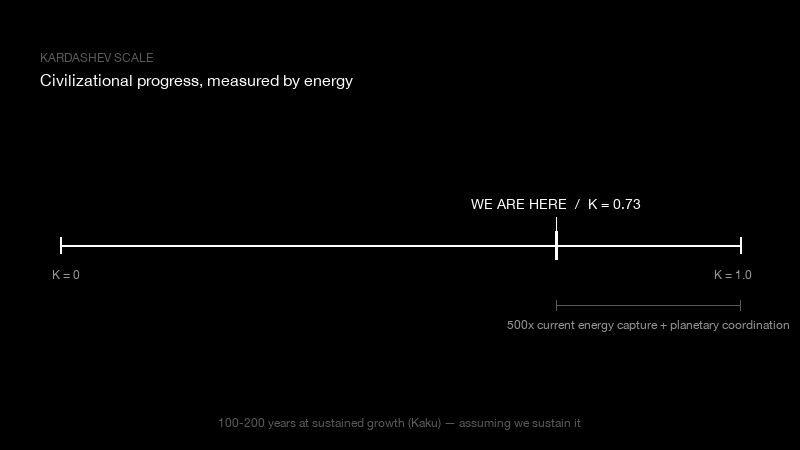
The remaining distance looks like an engineering problem.
Most of it is coordination.
Planetary energy systems, climate management, pandemic response, nuclear restraint, and the control of potentially catastrophic technologies all cross borders. The Paris Agreement is a legally binding treaty, but its nationally determined commitments depend heavily on domestic implementation and political will. It’s both a serious coordination achievement and evidence of how limited planetary governance remains.
The Fermi Paradox invites a darker speculation. Perhaps technological civilizations commonly acquire destructive capability before they acquire the institutions needed to manage it.
We have no observational evidence that civilizations “typically” end in the corridor between K=0.5 and K=1.0, and the silence of the universe doesn’t tell us that either. At most, it gives the hypothesis somewhere to sit.
Our own record is enough to show the recurring sequence. Agriculture made surplus governable and hierarchy scalable. Bronze linked power to fragile trade networks. Classical empires expanded administrative reach until the cost of scale destabilized them. Islamic scholarly networks demonstrated what becomes possible when translation and criticism cross borders. Print loosened control over reproduction, while gunpowder shifted the economics of force. Industry multiplied production and made labor rights a political battleground. Nuclear physics gave states species-level destructive capacity. Broadcast media concentrated narrative authority, the internet redistributed it and then reconcentrated attention, and AI is beginning to alter the production of knowledge itself.
In each case, capability arrived before a stable settlement. Institutions inherited the consequences, the people who benefited called the upheaval progress, and many of the people who lost experienced it as theft. Society eventually tried to build law, culture, organizations, and moral language around the new distribution of power, but the result was always partial and sometimes arrived only after catastrophe.
AI reached mass adoption in two months, and institutions still move in years and generations. We can’t slow the first clock back down to the second, so the only work left is speeding the second one up before the first decides what’s still possible.
Two months. That’s the whole problem.
Sources and Notes
- OpenAI, economic analysis of ChatGPT adoption.
- The Metropolitan Museum of Art, the origins of writing and early administrative tablets.
- Encyclopedia.com, William Ogburn’s cultural lag.
- David Collingridge, the social control of technology.
- Long Now Foundation, Stewart Brand’s pace layers framework.
- MIT Press, The Technology Fallacy.
- Nature Communications, one model of the Neolithic Y-chromosome bottleneck and a later nonviolent mechanism.
- Manchester Museum, Roman coinage and debasement during the third-century crisis.
- The Metropolitan Museum of Art, the translation of Greek texts into Arabic and Abbasid manuscript culture.
- Stanford Encyclopedia of Philosophy, Al-Ghazali.
- Cornell University ILR School, the Triangle fire and its legislative legacy.
- US Congress, Section 230: An Overview.
- US Department of State, the Nuclear Non-Proliferation Treaty.
- Government of Japan, the Iwakura Mission and Japan’s modernization.
- European Union, the AI Act.
- UNFCCC, the Paris Agreement.