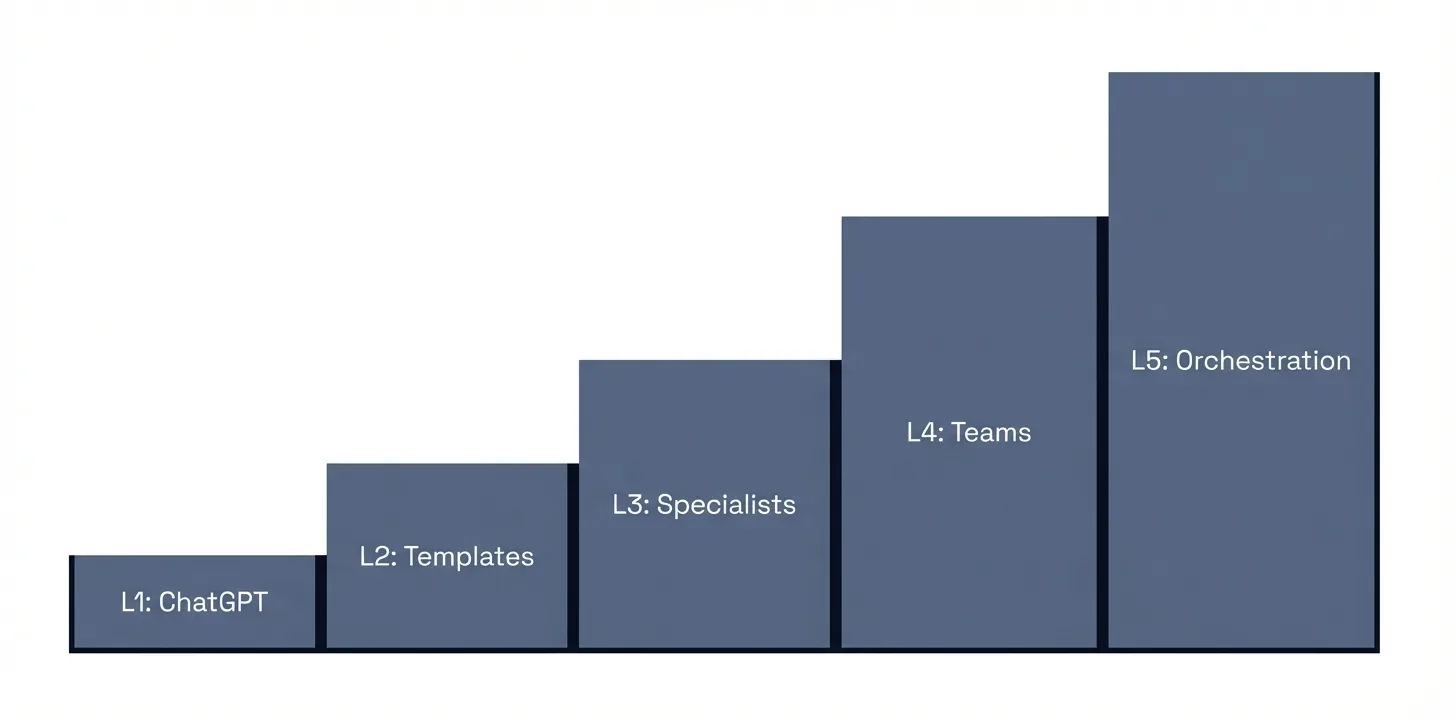
Most teams are stuck at Level 1 and think they’ve made it to Level 3.
That’s the single biggest pattern I see when people ask me to audit their AI setup. They have the subscriptions and the custom GPTs. Every Monday they’re still retyping the same instructions into a fresh chat window, wondering why the output feels generic. I’m not judging from a distance. I retyped the same prompt four times in one afternoon, down to the same “make it friendly but professional” qualifier, before admitting the problem was me.
The gap between using AI and building with AI is architectural, and no amount of better prompting carries you across it.
This article is the framework, five levels deep. For each one I’ve mapped the definition, the signals that tell you you’re stuck there, the failure mode that forces the next move, and the trigger that tells you it’s time. Use it as a diagnostic: find your level honestly, then move.
For the personal version of this journey, with all the mistakes and walls I slammed into, see Every Wall Between Prompts and AI Teams. This article is the structural companion.

Tools versus systems: the fork everything hinges on
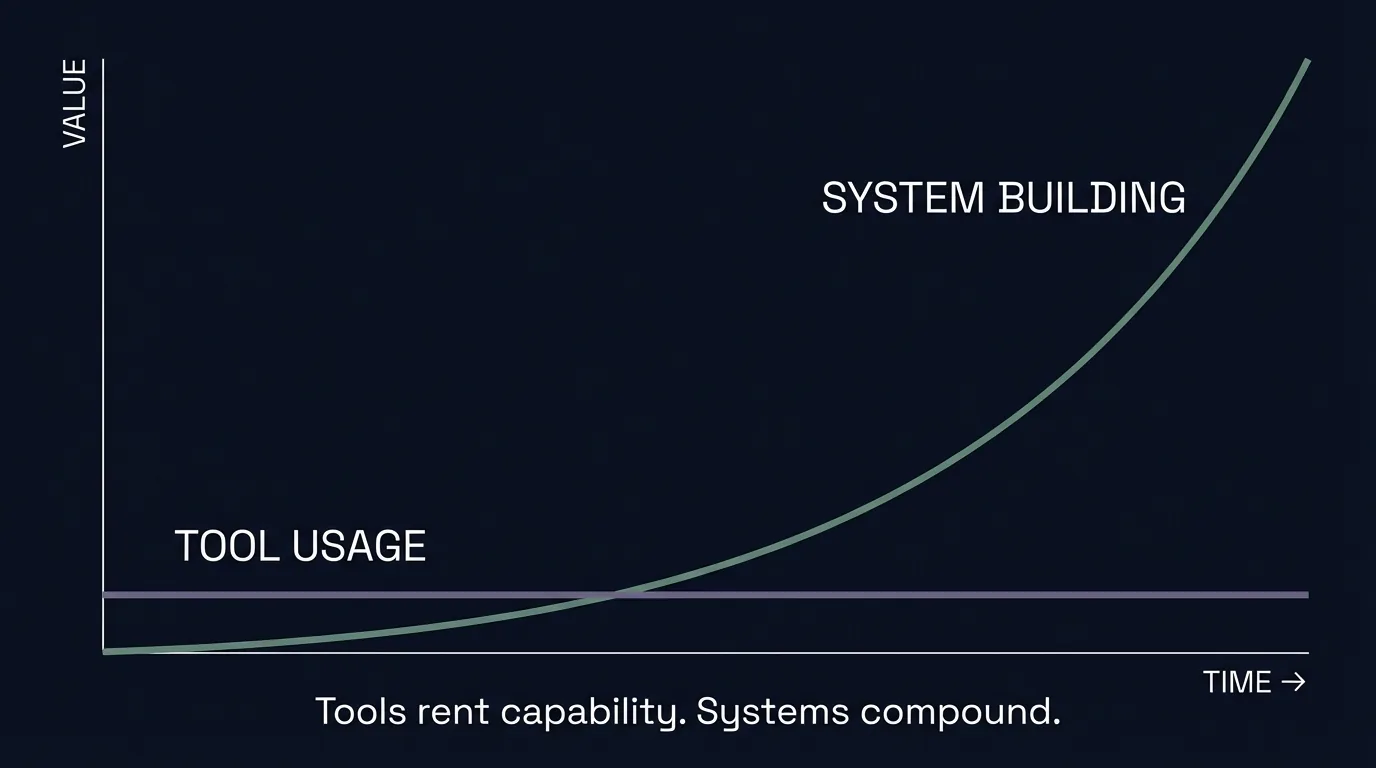
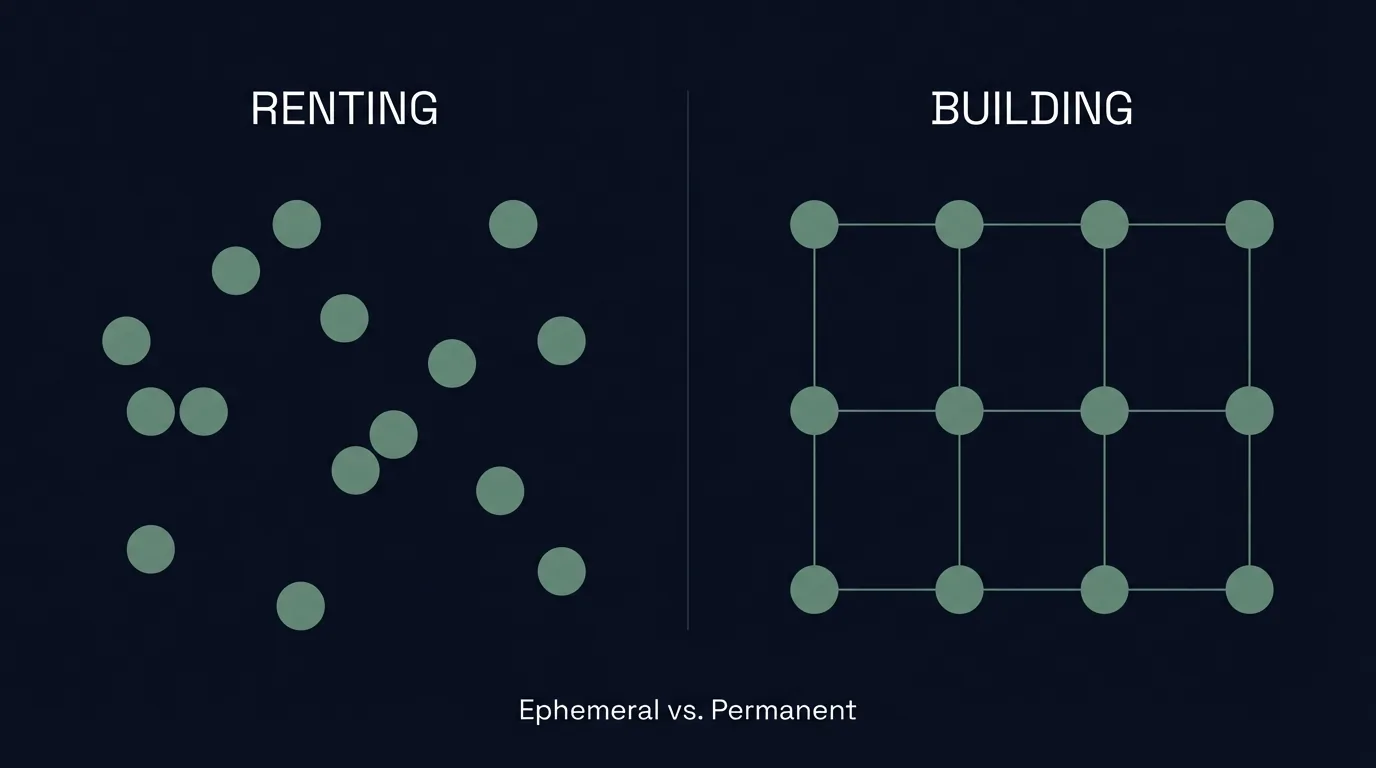
One distinction predicts everything else: if your AI usage doesn’t compound, you’re renting.
Tool usage feels productive, and compared to doing everything by hand it is a win. You open a window, type a prompt, get an output, and close the window. Tomorrow you start from zero, because nothing you taught it yesterday survived the night.
System usage compounds. Agents have defined roles, quality criteria you can measure, and workflows you can reuse. Whatever works gets captured and refined, and every project makes the next one better.
Level 1 and Level 2 are tool usage in different outfits, while Levels 3 through 5 are systems, each more coordinated than the last. Knowing which side of that line you’re on matters more than knowing your exact level.
The mechanism behind compounding: feedback loop integrity
From the outside, what seems to separate Level 5 from everything below it is scale: more agents, more elaborate architecture. Feedback loops separate the levels, and the agent count tends to rise alongside them.
Level 1 has no loop. You generate, you judge, you edit, and none of that signal gets back into the next session. Every error costs you a human intervention, and every correction dies the moment the chat window closes.
Level 5 closes the loop. Every agent declares what it needs and what it delivers, scores its own output, flags its own edge cases, and leaves an audit trail behind it, so every run produces signal the next run can correct against. That’s the part that accumulates.
That’s the engine: everything downstream gets stronger because the system catches its own errors before they cost you anything. What the levels measure is how much your system can learn from itself without you in the loop. Complexity is just what that looks like from the outside.
Level 1: The ChatGPT window
Definition: One human, one chat window, one prompt at a time, with no persistence, no role, and no validation. Every session starts cold.
Diagnostic signals: You retype similar instructions every week, you spend 15 to 30 minutes editing each output to make it sound like you, and quality swings wildly between sessions. There’s no version control for prompts, so you can’t explain why yesterday’s output was good and today’s isn’t.
Failure mode: You’re re-teaching the AI from scratch every use, paying a subscription for a tool you reintroduce yourself to every morning.
Upgrade trigger: The moment you notice you’ve pasted the same 300-word preamble four days in a row. Stop typing and start saving.

Level 2: Templates and Custom GPTs
Definition: Pre-loaded instructions that give consistent outputs without retyping: Custom GPTs, saved system prompts, Notion-stored briefs.
Diagnostic signals: A named assistant for each common task, outputs that hit 70 percent quality reliably, and marketing generating ten LinkedIn posts in the time one used to take. Everything sounds on-brand, and none of it is remarkable.
Failure mode: You’ve industrialized mediocrity. Templates are a real upgrade, and I remember thinking we’d made it. Then we pointed our SEO template at technical content and got keywords in all the right places around an answer that missed the search intent. Templates give consistency without giving depth. The Blog Post Generator uses the same structure for a feature launch and a thought-leadership essay because it can’t tell them apart: it has instructions where expertise should be.
Upgrade trigger: When edge cases break the template and you realize you’re the quality filter rescuing every output. That’s the template ceiling, and no amount of tweaking moves it.
What you need next is a different kind of building block: specialists.

Level 3: Specialized agents
Definition: Six specialists where you used to have one Blog Post Generator. An SEO Strategist, a Hook Architect, a Brand Voice Guardian, a CTA Specialist, a Technical Accuracy Reviewer, and a Visual Storyteller, each owning one domain and knowing why its role matters.
Diagnostic signals: Output per agent jumps to 85 to 90 percent, and for the first time it reads like domain experts wrote it. The SEO Strategist analyzes search intent and structures for featured snippets instead of stopping at keywords. The Hook Architect applies psychological frameworks.
Failure mode: Every agent is excellent. In conflicting directions. The SEO Strategist writes a keyword-stuffed headline the Brand Voice Guardian hates, and the Hook Architect writes a contrarian opener the CTA Specialist says misses the conversion goal. You become the human middleware, passing context between agents and losing 30 percent of it on every handoff. I spent weeks doing nothing but managing handoffs. Level 3 fails silently, because each agent thinks it did its job.
Upgrade trigger: When you spend more time translating between agents than evaluating their output. The specialists work and the coordination doesn’t, so adding another specialist stops helping. The fix is teams.

Level 4: Team-based agents
Definition: Multiple agents executing on the same project in parallel. A content workflow might involve twelve agents across a Research Team, a Creation Team, and an Optimization Team.
Diagnostic signals: Parallel execution is no longer theoretical: throughput is up and composite outputs hit 85 to 90 percent. Coordination has become its own full-time job.
Failure mode: Everyone finishes at different times and nobody standardized the handoff formats. The Hook Architect optimized for one psychological driver, the Audience Psychologist identified a different one, and nothing resolves the conflict. Every project becomes a negotiation, and when one agent stalls, the whole chain stalls. I spent a full week defining a workflow that wouldn’t bottleneck. The UI Designer needed to finish before the Frontend Developer could start, the Backend Architect was waiting on API specs, and the QA Engineer sat idle until everyone else delivered. Level 4 fails noisily, which is the one mercy: unlike Level 3, you can see the collision in real time.
Upgrade trigger: The moment you realize the bottleneck is structural and you can’t fix it by making any one agent smarter. You need a spec every agent answers to.
You have plenty of process, and the gap is architecture.

Level 5: Elite orchestration
Definition: Specialized agents organized into departments with clear mandates, documented workflows, and quality gates at every handoff. Engineering has six agents, Design has five, Marketing has six, Product has three, Testing has three, and Project Management has two. Every one answers to a production-grade spec (detailed below). This is what Alexandria, the platform I build and run today, eventually became after months of building, tearing down, and rebuilding.
Diagnostic signals: The system compounds without you in the middle of every workflow, and new projects benefit from refinements made on old ones. Quality increases with use rather than degrading with scale.
Failure mode: There’s a quiet one specific to Level 5, and it looks like success. You think you got here because you have many agents, but without spec discipline the system fragments into parallel Level 4s. Level 5 is defined by whether every agent in the system answers to the same spec contract, and agent count has nothing to do with it.
Upgrade trigger: There’s no Level 6. The work at Level 5 is maintaining spec discipline as you scale, so when you feel the urge to add another department, write its spec first.
The Five-Component Spec
This is what turns “collection of agents” into infrastructure. Five components per agent sounds like paperwork, and I get the urge to skip it when the agents seem to work. Every Level 5 agent is defined by the same five, and skipping any drops you back to Level 4.
1. Input/output validation
Every agent declares what it needs and what it delivers. The SEO Content Strategist requires a target keyword, a search intent analysis, and a competitive landscape, and it returns keyword clusters, structure recommendations, and an internal linking strategy. Missing inputs get flagged before work starts, which ends the “I didn’t have enough context” excuses.
2. Measurable quality criteria
Every agent is scored on weighted dimensions. The Blog Content Writer gets graded on narrative flow, technical accuracy, brand alignment, psychological resonance, SEO, and CTA effectiveness. A score below 92 percent triggers a self-critique loop where the agent explains why it fell short and proposes fixes.
3. Self-critique prompts
After generating output, every agent runs a self-evaluation. Does this hook use a recognized archetype, does the CTA align with the primary motivation from audience research, are there unexplained jargon terms? Quality control happens before human review, not after.
4. Edge case documentation
Every agent documents its known failure scenarios. The Twitter/X Specialist knows it struggles with deeply technical audiences because engineers prefer depth over snark, so when a brief matches a documented edge case the agent warns you: “Content targets CTOs. Contrarian hooks may backfire. Consider Question archetype instead.”
5. Real examples
Every agent ships with five to ten examples of excellent work: articles with 10,000-plus views and conversion data from campaigns that shipped. Agents pattern-match against that proven success.
What this unlocks
Every handoff has a format, every quality check has criteria, and every failure has documentation, so the system gets better with use and the gains compound.
ROI across industries
Content ops is the obvious home for a framework like this, and the fair objection is that it doesn’t travel. But builders hitting Level 4 and Level 5 in very different domains report the same shape of result.
- Education. 60 to 70 percent time savings on lesson planning, assessment design, and curriculum development. Level 5 result: spec-based agent departments handling content ops with standardized handoffs, and the numbers only land because the same spec governs every handoff.
- Gaming. Eight-person studios shipping on timelines that used to require 25 to 30 people. Level 5 result: full departmental orchestration replacing headcount instead of supplementing it, which isn’t possible below Level 5 because coordination overhead eats the gain.
- Fitness and health. 30 percent conversion lift on coaching funnels that moved from templates to orchestrated specialists, with ~$85K per month revenue impact in one case. Level 4 result: the jump from Level 2 templates to coordinated specialist agents captured most of the gain. Level 5 adds the audit trail without adding to the conversion lift.
- Finance and compliance. Up to 80 percent reduction in compliance review cycle time, with back-office cycles collapsing from days to hours. Level 5 result: spec-based orchestration with audit trails built into every handoff, because regulated industries need the documentation layer that only Level 5 produces.
Different industries, same mechanism: systems that close their own loops beat tools that don’t.
Diagnostic: find your level
Honest answers only, meaning where you operate day-to-day rather than where your LinkedIn bio says you are.
| Level | You’re here if… | The trap | Your next move |
|---|---|---|---|
| 1 | You open fresh ChatGPT sessions and retype instructions every week. | You think saved prompts in a Notion doc mean you have a “system,” but saved text is still tool usage because the AI can’t read your Notion. | Save one prompt today and make it reusable this week. |
| 2 | You have Custom GPTs for every workflow and every output hits the same 70 percent quality ceiling. | You think Custom GPTs are specialists, when they’re templates with personality: better prompts, no domain expertise. | Decompose your highest-volume task into 3-4 specialist roles and build them separately. |
| 3 | Your specialists do excellent work individually but you’re the one shuttling context between them on every project. | You think multiple named agents make a team, when what you have is specialists with no shared language. | Standardize the handoff format before adding another specialist: JSON schema or structured output, pick one and enforce it. |
| 4 | Your agents run in parallel and produce high-quality composite outputs, but coordination takes more time than review. | You think parallel execution equals orchestration, when it’s chaos with more agents in it. | Write the five-component spec for one agent, ship it, measure the difference, and repeat. |
| 5 | The system compounds without you in the middle of every workflow, and new projects benefit from old project learnings. | You think Level 5 is about agent count when it’s about the spec. You can be Level 5 with 6 agents and Level 4 with 60. | Stay here and maintain spec discipline as you scale, with every new department shipping its spec first. |
If you’re stuck, here’s what to do
The table gives the one-line move; this is the longer version.
Stuck at Level 1. Save one prompt today and turn it into a reusable template this week. That’s the whole move. Infrastructure can wait, because right now you need to stop retyping.
Stuck at Level 2. Pick your highest-volume content type and decompose it into the three or four specialist roles it requires. Build those agents separately, even if coordination is manual for now. Specialization comes before orchestration.
Stuck at Level 3. Standardize your handoff format before you add another specialist: JSON schema or structured output, pick one and enforce it. Most Level 3 teams think they need better agents when what they need is better interfaces between agents.
Stuck at Level 4. Write the five-component spec for one agent. Just one, with input/output validation, quality criteria, self-critique, edge cases, and real examples, then ship it, measure the difference, and do the next one. Level 5 gets built one spec at a time, never in a big-bang redesign.
The real question
Most people use AI like a hammer: one tool, one function, swung when you need it and put down when you’re done. Nothing carries over to the next swing.
Elite systems use AI like an orchestra: specialized agents, each with clear expertise, coordinated by a score that says when each section enters and how they harmonize.
So what changes between the hammer and the orchestra? The kind of output, since volume is the part everyone measures and the part that matters least.
Agentic AI works. The open question is whether you’re willing to build systems that close their own loops.
This framework comes from building production agentic systems at scale. For the personal narrative of how I got here, including what I got wrong at each level, read Every Wall Between Prompts and AI Teams.