
Recently I’ve been reading up on the fears around the looming recession as the US and most of the world are looking to figure out this runaway inflation thing. It got me thinking about all the moving parts that got us here and, more importantly, what it holds for our future.
In one sentence: The free and open capital exchange through games will cause developing nations to reorientate their economic climate as options to make a relatively high income from digital work (aka games) becomes more lucrative.
What I will be covering
- Historical norms
- What’s changing
- Why it’s a big deal
- How Web3 Gaming changes it all
Historical norms
Simply put, the characteristics of globalization are based on the growth of modern financial systems. Hardly a giant leap, but let me explain.
The history of our developing global trade system is shockingly young at roughly 500 years old, sorry Xi’an and The Silk Road, but the amount of worldwide trade and inconsistency was not enough to be counted in the World Economic Forum’s A brief history of globalization. So, to sum it up briefly, here are the five eras of globalization and the five W’s of each.
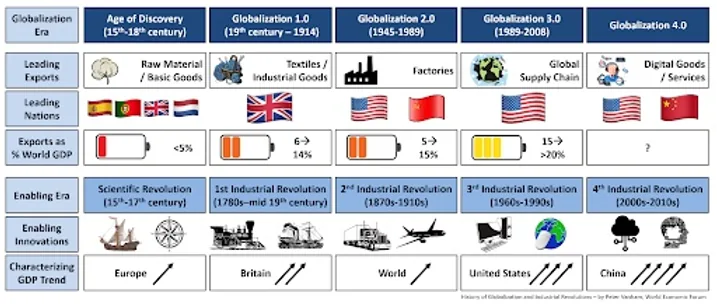
While the WEF’s article outlines the development of the physical infrastructure and the technological breakthroughs, it shouldn’t shock anyone that money flow was the main factor that fueled the growth in global trade. It’s specifically called out in this specific passage:
In short, this reciprocal relationship between the flow of money and technological breakthroughs pushes globalization forward.
The development of the modern financial system and what Niall Ferguson coined as “financial selection” has attacked the vulnerable and backed the strong. Basically, this is the economic version of natural selection, only the evolution of our local and global financial systems.
For example, the development of our first modern banks in Italy coincides with the beginning of the Age of Discovery, the Netherland’s initial version of stock markets with the “First Wave,” and the US’s deregulation of property with the “Second Wave.”
Access to the financial system and capital is the primary means of any economic growth as a nation, just as an individual. I’m sure you see where this is going when we start to connect it to blockchain tech.
*For deeper context, I highly suggest reading The Ascent of Money, but because this is 2022, here is a 30-min overview that hits the main points reasonably well. Listen to it on 1.5x speed ;)
What’s changing
Traditionally, the innovation cycles were slightly slower than today, and I’m not just talking about TikTok fads. The advancement of physical and financial technology allowed first-mover advantage in ways that are not as substantial, as there are many ways to “catch up” or even “leapfrog.”
The internet has allowed individuals to extend their reach beyond their local economies, increasing their earning potential. A real example is migrant or seasonal workers understanding the demand in certain areas, sites like Upwork, Fiverr, etc., pushing the gig economy, or everyone’s favorite side hustle: drop shipping. Each now depends on the internet to find or perform the job’s essential functions.
Now that most of the world (~5 billion, or 63%) is connected to the internet and new ways of getting to those hard-to-reach places with satellites, we should expect a more significant technological and economic connection. Which means smaller countries that lean on the IMF or World Bank may soon have somewhere else to look.
Why it’s a big deal
Beyond the access to financial systems, speed and openness are other factors to consider. For an easy example, many people have gone through the hassle of renting or purchasing a home. There are screens, loads of documents, and likely an interview or two, all in the name of securing confidence by both parties before committing high-value transactions. Vehicles and some luxury goods are generally the same way. I mean, just transferring more significant sums of money from one bank account to another can come with a few pieces of red tape.
Capital moves easily now, and almost freely. Crypto ties the global economic system tighter than it has ever been.
I’ll use something everyone reading would know: NFTs. I don’t want to focus on the hype of 2021 (I’m on record for a big crash this year). Still, typically to purchase anything that takes considerable capital, several players are involved with many steps along the way. Not to mention the usual paperwork that comes with big purchases. You want a house? Minimum a few weeks. A car? If you’re buying cash (never do this), you’ll hear, “I’ll get the paperwork ready!” In contrast, you want that $2m NFT? Click. You’ve moved the money instantly and pseudonymously, and here’s your Ape Punk.
NFTs
I believe this is why we saw the quick push to regulate crypto in countries that would likely have net outflows of their currency, like China. It could have become easy to funnel money out of the country for the middle and upper class. For context China only allows ~$50k per year to be transferred out of the country, a huge pain point for those moving their lives abroad. Thus making crypto very enticing to those wanting to move their wealth out but ultimately causing a noticeable ripple effect.
Luckily for larger nations, this may not be such a big deal, but these effects are becoming more frequent and at greater magnitudes, especially for smaller economies. The unfortunate truth is we have a system that relies on the output capacity of developing nations for their cheap labor. Thus far, when countries have become more expensive, the production has been moved to a different nation or Economic Zone willing to do it for a more competitive price. Opening access to capital competes with this model, as these nations would now have more options, likely creating magnitudinal shocks.
For example, considering supply chain issues caused by the Covid-19 pandemic, essential goods had trouble getting made as factory workers stayed home. This put pressure on general purchases like food, clothing, and electronics. Not to mention the shipping industry, truck driver shortages, and widespread labor shortages (minus the Great Resignation) leading to changing prices (inflation).
How Web3 Gaming changes it all
With roughly 3.1 billion gamers globally, games have fully bridged the gap between themselves and traditional entertainment. The combination of powerful mobile devices and F2P gaming allowed the proliferation of games into most of the world’s pockets. Now there is a burgeoning tech in web3.
I’ll use Axie Infinity as an example. Axie showed what could happen when users are presented with an alternative value proposition: P2E (I hate this name, btw). What’s most surprising is that Axie is/was a weak game and lacks much of what modern games have, but it displayed new incentives and the shocking demand for them.
Sure, you could have made money in games before, mainly gold farming or running item arbitrage in RPGs, but relatively small amounts. Since these early attempts, relatively new occupations of professional videogame player and streamer had been the industry’s only consumer side user able to capitalize on meaningful income models. To put it in perspective, Axie had four options to earn within the game: selling rewards like Sweet Love Potions (a rare and needed currency), staking $ASX token, breeding and selling unique and powerful Axies, and land rentals or sales. Remember, this is a first trial to prove some basic use cases for crypto in games!
The amounts players were earning were highly publicized, mainly in developing countries. As new options for earning income become available to more of the world’s population, we could be presented with a loss of output, especially when factoring in the tradeoff from physical labor to digital labor. This change would make the knock-on effects of covid look minimal since this would be a shift in occupation, not a hiatus due to a relatively short-term event.
Just think what happens when you have a miner, farmer, seasonal/migrant worker, laborer, etc., presented with a new occupational option that pays better, is safer, and offers the flexibility of the most seasoned digital nomad. Looking at the average income per month of highly populated developing countries like India ($160), Indonesia ($323), and Pakistan ($106), it makes sense why the crypto adoption rate is so high there.
We’re in the early days of crypto and essentially at the birth of crypto gaming, but it’s clear that there is much to improve upon in the game space. However, one thing keeps me bullish on web3: All things equal and presented with the two alternatives, why would a user not choose crypto gaming? It gives a player more agency. It also moves capital across the world’s economies.